These cookies and other information are strictly necessary for our services to function correctly. They guarantee that our service works securely and functions the way it is supposed to. Consequently, you cannot deactivate these cookies.
To cookie policy

Can you build working prototypes of an app integration for iOS, Android, and the web in two days by changing nothing but the documentation?
That is exactly the experiment we attempted at this year's CHECK24 hackathon, the Plugin Impossible CHECKathon. Sixty software developers and product managers from CHECK24 locations across Germany took on the challenge at our headquarters in Munich.
All teams worked with the same documentation and the same three prompts: one for iOS, one for Android, and one for the web. The task was to build a new CHECK24 comparison product while changing only the documentation. Neither the prompts nor the code could be adjusted manually - true to the motto of the Plugin Impossible CHECKathon: from Doc to Prod(uct).
“Every Build Is Like Playing a Slot Machine”
After the development phase came the debrief: how did coding without writing code actually work? For some, every build felt like a gamble. The same prompt and minimal changes to the documentation often produced a completely different result when generated again. “Suddenly, chess pieces appeared on the results page of our robot comparison, and we had no idea where they came from,” one developer reported.
Context Engineering Is the New USP for Developers
Philipp Kemper (CHECK24 CTO) had already anticipated this experience in his opening keynote. He described context engineering as the new core competency for developers: deliberately controlling the information available to an AI within its context. Part of this context is static and available with every request, such as global instructions or central rules. Other context is loaded dynamically. Relevant skills, documents, or tool results only enter the context when they are needed for the task at hand. Context engineering therefore determines not only what the model knows, but also when it knows it.
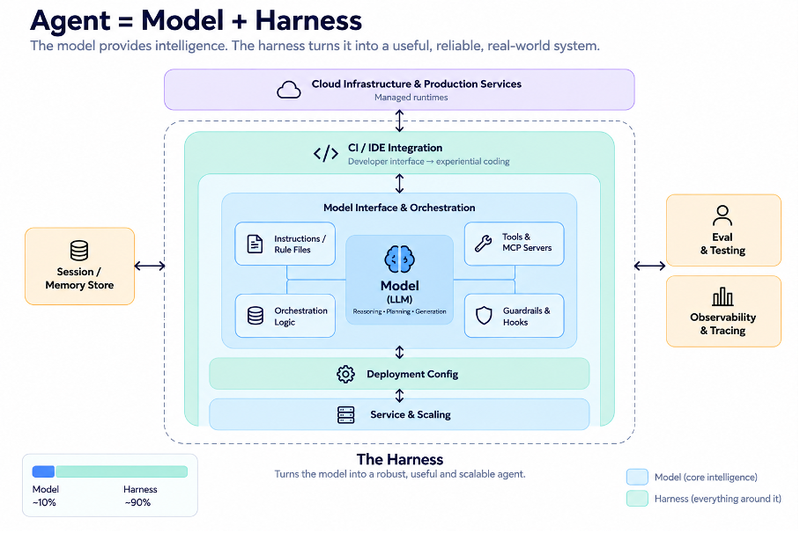
Adapted from Fig. 7, Osmani, Addy; Saboo, Shubham; Kartakis, Sokratis (2026): The New SDLC With Vibe Coding. Kaggle.
Invest in the Harness, not just the Model
This is exactly where the harness comes into play. An agent consists not only of the model, but of the interaction between the model and the harness. The harness is the technical environment in which the model operates.
This was precisely what made the CHECKathon so interesting: we did not manually adjust either the model or the code. We only changed the documentation, thereby influencing part of the context. The harness, however, remained unchanged and, alongside impressive results, also produced the observed “gambling builds.” This gave our developers first-hand experience of just how important a good harness is. Philipp's recommendation for day-to-day development followed directly from this: “Invest in the harness, not just the model.”
Source: Osmani, Addy; Saboo, Shubham; Kartakis, Sokratis (2026): The New SDLC With Vibe Coding. Kaggle.